
Saturday, May 3, 2014


Friday, May 2, 2014
Filtering content on the internet - Chinmayi Arun

Disintegrating into binaries
The petition assumes that pornography causes violence against women and children. The trouble with such a claim is that the debate disintegrates into binaries; the two positions being that pornography causes violence or that it does not. The fact remains that the causal link between violence against women and pornography is yet to be proven convincingly and remains the subject of much debate. Additionally, since the term pornography refers to a whole range of explicit content, including homosexual adult pornography, it cannot be argued that all pornography objectifies women or glamorises violent treatment of them.
Allowing even for the petitioner’s legitimate concern about violence against women, it is interesting to note that of all the remedies available, he seeks the one which is authoritarian but may not have any impact at all. Mr. Vaswani could have, instead, encouraged the state to do more toward its international obligations under the Convention on the Elimination of Discrimination against Women (CEDAW). CEDAW’s General Recommendation No. 19 is about violence against women and recommends steps to be taken to reduce violence against women. These include encouraging research on the extent, causes and effects of violence, and adopting preventive measures, such as public information and education programmes, to change attitudes concerning the roles and status of men and women.
Child pornography
Although different countries disagree about the necessity of banning adult pornography, there is general international consensus about the need to remove child pornography from the Internet. Children may be harmed in the making of pornography, and would at the very minimum have their privacy violated to an unacceptable degree. Being minors, they are not in a position to consent to the act. Each act of circulation and viewing adds to the harmful nature of child pornography. Therefore, an argument can certainly be made for the comprehensive removal of this kind of content.
Indian policy makers have been alive to this issue. The Information Technology Act (IT Act) contains a separate provision for material depicting children explicitly or obscenely, stating that those who circulate such content will be penalised. The IT Act also criminalises watching child pornography (whereas watching regular pornography is not a crime in India).
Intermediaries are obligated to take down child pornography once they have been made aware that they are hosting it. Organisations or individuals can proactively identify and report child pornography online. Other countries have tried, with reasonable success, systems using hotlines, verification of reports and co-operation of internet service providers to take down child pornography. However, these systems have also sometimes resulted in the removal of other legitimate content.
Filtering speech on the Internet
Child pornography can be blocked or removed using the IT Act, which permits the government to send lists of URLs of illegal content to internet service providers, requiring them to remove this content. Even private parties can send notices to online intermediaries informing them of illegal content and thereby making them legally accountable for such content if they do not remove it. However, none of this will be able to ensure the disappearance of child pornography from the Internet in India.
Technological solutions like filtering software that screens or blocks access to online content, whether at the state, service provider or user level, can at best make child pornography inaccessible to most people. People who are more skilled than amateurs will be able to circumvent technological barriers since these are barriers only until better technology enables circumvention.
Additionally, attempts at technological filtering usually even affect speech that is not targeted by the filtering mechanism. Therefore, any system for filtering or blocking content from the Internet needs to build in safeguards to ensure that processes designed to remove child pornography do not end up being used to remove political speech or speeches that are constitutionally protected.
In the Vaswani case, the government has correctly explained to the Supreme Court that any greater attempt to monitor pornography is not technologically feasible. It has pointed out that human monitoring of content will delay transmission of data substantially, will slow down the Internet, and will also be ineffective, since the illegal content can easily be moved to other servers in other countries.
Making intermediaries liable for the content they host will undo the safe harbour protection granted to them by the IT Act. Without it, intermediaries like Facebook will actually have to monitor all the content they host, and the resources required for such monitoring will reduce the content that makes its way online. This would seriously impact the extensiveness and diversity of content available on the Internet in India. Additionally, when demands are made for the removal of legitimate content, profit-making internet companies will be disinclined to risk litigation much in the same way as Penguin was reluctant to defend Wendy Doniger’s book.
If the Supreme Court makes the mistake of creating a positive obligation to monitor Internet content for intermediaries, it will effectively kill the Internet in India.
(Chinmayi Arunisresearch director, Centre for Communication Governance, National Law University, Delhi, and fellow, Centre for Internet and Society, Bangalore.)
Courtesy & Soucrce: http://www.thehindu.com/todays-paper/tp-opinion/filtering-content-on-the-internet/article5967959.ece
M.S. Pattabhiraman passes away

M.S. Pattabhiraman (90), former vice-president of the Music Academy, passed away on Thursday afternoon.
Apart from his involvement with Carnatic music promotion in the Music Academy, he was an active Rotarian and supporter of social and religious causes and Chairman of the Kedarampatti Swamy Trust in Kancheepuram.
He is survived by daughter Tara Murali and two sons, Ramesh Pattabhiraman and P. Vasanthkumar. The last rites and cremation were performed on Thursday evening at Mylapore.
Narada Gana Sabha secretary R. Krishnaswami recalled Mr. Pattabhiraman’s association with the Sabha in the 1960s. “He was a supporter of good causes and during his two terms as a committee member of the Narada Gana Sabha in our infant stages, he was very supportive,” he said.
Veena maestro and Vice-Chancellor of Tamil Nadu Music and Fine Arts University E. Gayathri said that Mr. Pattabhiraman was a very fine gentleman and both Ms. Sulochna, his wife, and he were connoisseurs of music and art. “Though he held a very senior position in the Academy, he would not show it. I always regarded him in a special light,” she said.
Renowned Bharathanatyam artist and guru Sudharani Raghupathy recalled that Mr. Pattabhiraman was a great soul and loveable person.
“Inspite of his age, he would take the trouble to appreciate artists, including the very young ones. Usually people are very stingy with kind words, but he was a man who had a kind word for everyone,” she said.
Know where your ancestors lived 1,000 years ago
In a groundbreaking research, scientists have developed a tool that can trace back the place where your DNA was formed up to 1,000 years ago.
The revolutionary Geographic Population Structure (GPS) tool works similarly to a satellite navigation system.
“What we have discovered here at the University of Sheffield is a way to find out where your DNA was formed up to 1,000 years ago by modelling these admixture processes,” said Eran Elhaik of University of Sheffield.
Genetic admixture occurs when individuals from two or more previously separated populations begin interbreeding. This results in the creation of new gene pools representing a mixture of the founder gene pool.
“What is remarkable is that, we can do this so accurately that we can locate the village where your ancestors lived hundreds and hundreds of years ago,” Elhaik added.
To demonstrate how accurate GPS predictions are, the researchers analysed data from 10 villages in Sardinia, the second largest island in the Mediterranean Sea and over 20 islands in Oceania.
The researchers were able to place a quarter of the residents in Sardinia directly to their home village and most of the remaining residents within 50 km of their village. They also achieved 90 percent success of tracing islanders in Oceania exactly to their island
The study appeared in the journal Nature Communications. — IANS
Thursday, May 1, 2014
Article on May Day Park Chennai ( The Hindu News Paper - Chennai's park with a past - SRIRAM V.)

Summers are best spent away from Chennai and if you are stuck here, it is best to remain indoors with a powerful air conditioner and a tall cooling drink by your elbow. But if you are the outdoors variety then May Day Park is probably one location that you could visit. Its tall shade-giving trees, green lawns and herbaceous borders are the most soothing sights on a hot day. You access it from Anna Salai, taking a left along Simpson & Co. And there, just opposite the Chintadripet MRTS station is the park, all 14.5 acres of it.
In 1849 or thereabouts, all of this area, Simpson, The Hindu, The Mail and P Orr & Sons included, was one large property, occupied by Burghall’s Stables, a firm that was into the hiring out of horse carriages and the manufacture of saddles and livery. In 1869, a part of its land was handed over to the Government for the creation of a park. It was named after the then Governor, Francis, 10 Lord Napier and 1 Baron Ettrick. Entrusted to the Municipality in 1879, it became in time a much-required green lung for the Chintadripet area.
It is quite likely that much of the lush greenery here is due to sewage. In the 1860s, when underground drains were yet to make their appearance, the largely organic sewage in various parts of the city was drained into specially designated farms. Napier Park received the sewage of entire South Madras. One of the first modern sewage pumping stations was set up here in 1932 and Pumping Station Road next to the park commemorates this.
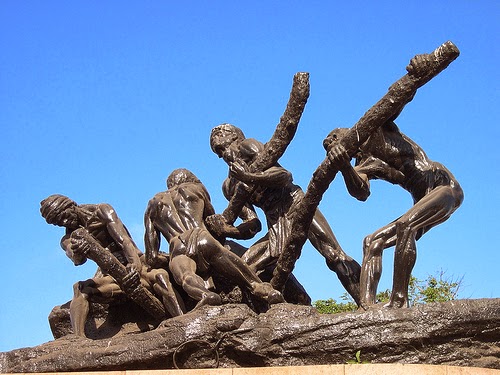
There is very little apart from the greenery to see and admire in the park. At the extreme left, HT Boddam, a highly unpopular judge from the early 1900s glowers down at you from below an ornate canopy. At the opposite end is an elegant Ashok Pillar, unveiled in 1966 by actor S.S. Rajendran. In the middle is what is best avoided – a gruesome rockery, commemorating the change of name to May Day Park in 1990. Madras was the first city in India to observe May Day, way back in 1923 under the leadership of M. Singaravelar. The park itself had much to do with the city’s labour history, being next to what was one of the biggest employers before modernisation brought numbers down – Simpson & Co. Known for militant labour unionism in the 1960s and ’70s, it is here that the workers of the company meet even today, on May 1.
On January 25, 1965, thousands of students marched from Napier Park to Fort St George as part of the anti-Hindi agitation. The then Chief Minister M. Bhaktavatsalam refused to meet them and tear gas shells were exploded injuring many. That treatment of students is even now believed to be one of the reasons for the Congress defeat in 1967, after which it has never come to power in Tamil Nadu.
Courtesy & Source: http://www.thehindu.com/features/metroplus/society/chennais-park-with-a-past/article5928723.ece
May Day
 May Day on May 1 is an ancient Northern Hemisphere spring festival and usually a public holiday; it is also a traditional spring holiday in many cultures. May Day coincides with International Workers' Day, and in many countries that celebrate the latter, it may be referred to as "May Day".
Traditional May Day celebrations
May Day is related to the Celtic festival of Beltane and the Germanic festival of Walpurgis Night. May Day falls half a year from November 1 – another cross-quarter day which is also associated with various northern European paganisms and the year in the Northern Hemisphere – and it has traditionally been an occasion for popular and often raucous celebrations.
As Europe became Christianized, the pagan holidays lost their religious character and either changed into popular secular celebrations, as with May Day, or were merged with or replaced by new Christian holidays as with Christmas, Easter, and All Saint's Day. In the 20th and continuing into the 21st century, many neopagans began reconstructing the old traditions and celebrating May Day as a pagan religious festival again.[3] Note that the source noted does not support any of the changes claimed by the previous statement. The only significant Christianization of May day is essentially localized to Germany where it is one of many historic days that were used to celebrate St. Walburga (the saint credited with bringing Christianity to Germany).
Origins
The earliest May Day celebrations appeared in pre-Christian times, with the festival of Flora, the Roman goddess of flowers, and the Walpurgis Night celebrations of the Germanic countries. It is also associated with the Gaelic Beltane. Many pagan celebrations were abandoned or Christianized during the process of conversion in Europe. A more secular version of May Day continues to be observed in Europe and America. In this form, May Day may be best known for its tradition of dancing the maypole dance and crowning of the Queen of the May. Various Neopagan groups celebrate reconstructed (to varying degrees) versions of these customs on May 1.
The day was a traditional summer holiday in many pre-Christian European pagan cultures. While February 1 was the first day of Spring, May 1 was the first day of summer; hence, the summer solstice on June 25 (now June 21) was Midsummer.
In the Roman Catholic tradition, May is observed as Mary's month, and in these circles May Day is usually a celebration of the Blessed Virgin Mary. In this connection, in works of art, school skits, and so forth, Mary's head will often be adorned with flowers in a May crowning.
Fading in popularity since the late 20th century is the giving of "May baskets", small baskets of sweets and/or flowers, usually left anonymously on neighbors' doorsteps.
Courtesy & Source: http://en.wikipedia.org/wiki/May_Day
Subscribe to:
Posts (Atom)